

Introduction
Most businesses begin with an idea: a product people need, a service that fills a market gap, or a skill that could become a source of income. Turning that idea into a sustainable business, however, requires more than enthusiasm. Without a clear plan, founders can waste resources, struggle to attract customers, and make decisions without knowing whether they are moving toward their goals.
Successful business planning starts with clear objectives, an understanding of customer needs, and realistic financial expectations. Businesses also need to decide where to compete, which opportunities to pursue, and how to use their resources effectively. These decisions provide direction and help business owners focus on activities that support long-term growth.
Business Planning and Strategy work together to turn an idea into an actionable roadmap. Business planning defines what a company wants to achieve, what resources it needs, and how its operations will work. Business strategy determines how the company will compete, differentiate itself, and create value for its customers.
In this guide, you will learn how to develop a business plan, set measurable goals, conduct market research, analyze competitors, and make informed decisions. You will also explore financial planning, risk management, competitive advantage, and practical problem-solving. Whether you are launching a startup or improving an existing business, these concepts will help you make more deliberate decisions and build a clearer path toward sustainable growth.
1. What Is Business Planning?
Business planning is the process of deciding how a business will operate, use its resources, serve customers, and achieve its objectives. It involves evaluating opportunities, estimating costs, identifying challenges, and establishing a practical direction for the company’s future.
A business plan is the written result of this process, but the thinking behind it is equally important. Planning encourages business owners to examine their assumptions before committing significant time or money.
Why Business Planning Is Important
Every business operates with limited resources. Even a promising company can struggle when its spending, priorities, and operations are poorly organized. A clear plan helps owners determine which activities deserve attention and which can wait.
Business planning also helps companies prepare for uncertainty. By estimating expenses, researching customers, and identifying potential risks, owners can make informed decisions instead of reacting to every unexpected problem.
For example, a freelance designer who plans monthly expenses, expected client payments, and available working hours can determine how many projects are needed to maintain a stable income.
Key Elements of Effective Business Planning
Effective business planning generally includes:
- Business objectives and measurable targets.
- Products or services and their value to customers.
- Target audience and market opportunities.
- Marketing, sales, and customer acquisition.
- Financial forecasts, expenses, and cash flow.
- Operational processes and resource requirements.
- Potential risks and contingency plans.
- Performance measures and review schedules.
These elements should support one another. Sales targets must reflect market demand, financial forecasts must account for operating costs, and operational plans must provide enough capacity to deliver what the business promises.
Common Business Planning Mistakes
Common mistakes include relying on unrealistic revenue projections, ignoring competitors, setting vague objectives, and failing to update the plan. Another mistake is treating the business plan as a document that only needs to be written once.
A useful plan is a working tool. Review it regularly, compare expectations with actual results, and revise assumptions when new evidence becomes available.
2. Business Plan Development: How to Create a Business Plan
Business plan development turns a business idea into a structured document explaining what the company will offer, whom it will serve, how it will operate, and how it expects to earn money. It can guide everyday decisions and help lenders, investors, and potential partners understand the opportunity.

Essential Components of a Business Plan
A comprehensive business plan commonly includes:
- Executive summary: An overview of the business, its goals, market opportunity, and financial needs.
- Company description: The business’s purpose, structure, objectives, and value proposition.
- Products or services: What the company sells and how it addresses customer needs.
- Market analysis: Target customers, market demand, industry conditions, and competitors.
- Marketing and sales strategy: How the business will attract customers and generate sales.
- Operations plan: How products or services will be delivered.
- Management and organization: Who will manage the business and what responsibilities they hold.
- Financial plan: Startup costs, revenue forecasts, expenses, cash flow, and funding requirements.
The level of detail depends on the purpose of the plan. A founder preparing for personal use may need a concise document, while a company seeking financing may need more detailed financial projections and supporting evidence.
Step-by-Step Business Plan Development
Step 1: Define the business idea. Explain what you sell, which problem you solve, and why customers might choose your offer.
Step 2: Research the market. Investigate customer needs, purchasing behavior, market demand, and competing alternatives.
Step 3: Establish your business model. Determine how revenue will be generated, how products will be delivered, and what costs are involved.
Step 4: Develop an operational plan. Identify suppliers, equipment, technology, staffing, and processes.
Step 5: Create a marketing and sales plan. Choose appropriate channels for reaching potential customers and converting interest into purchases.
Step 6: Prepare financial projections. Estimate startup expenses, monthly operating costs, sales, cash flow, and the amount of funding required.
Step 7: Set measurable goals. Establish targets, deadlines, and indicators for evaluating progress.
Step 8: Write the executive summary. Summarize the completed plan after the main sections are developed.
For additional practical support, entrepreneurs can explore business plan templates and planning guidance to organize the document and evaluate the information required for their business.
Example of a Simple Business Plan
Consider a hypothetical home-cleaning service. Its business plan might identify working households in selected neighbourhoods as its target market, outline available cleaning packages, establish service prices, and estimate equipment, transportation, and staffing costs.
The plan could also calculate how many bookings are needed each month to cover expenses. If the business expects more bookings than its staff can handle, it must adjust its hiring or scheduling before launching a large marketing campaign.
This example illustrates why a business plan should connect customer demand, operations, financial requirements, and business objectives.
3. Business Models and Revenue Planning
A business model explains how a company creates value for customers and earns revenue from delivering that value. Revenue planning translates the model into financial estimates that help owners assess whether the business can support its costs and objectives.

Two businesses can sell similar products but operate through different business models. One might sell directly to customers, while another might use subscriptions, distributors, or licensing agreements.
Common Types of Business Models
Several models are widely used across industries:
- Direct sales: Customers pay for individual products or services.
- Subscription: Customers pay recurring fees for continued access or delivery.
- Service-based: Customers pay for expertise, labour, or completed projects.
- Commission-based: The business earns a fee for facilitating transactions.
- Advertising-based: Revenue comes from advertisers or sponsors.
- Licensing and franchising: Other parties pay to use intellectual property, a brand, or an established business system.
- Marketplace: The company connects buyers and sellers and may charge transaction fees.
The appropriate model depends on customer preferences, delivery costs, competition, and the resources available to the business.
How to Develop a Revenue Plan
Begin by identifying the products or services that generate income. Establish realistic prices, estimate the number of customers you can reach, and calculate how frequently they may purchase.
For example, a business selling 150 products per month at PKR 2,000 each would generate PKR 300,000 in monthly sales revenue. This figure is not profit. The business must still pay for inventory, delivery, salaries, rent, marketing, taxes, and other expenses.
Revenue forecasts should include assumptions about sales volume, pricing, customer retention, and seasonal demand. Preparing conservative, expected, and optimistic scenarios can reveal how different outcomes affect the business.
Evaluating Business Model Profitability
A business model must generate enough revenue to cover its costs and provide an acceptable return. Recurring revenue can improve predictability, but subscriptions also require ongoing customer satisfaction and retention.
A one-time sales model may be simpler to manage, but it often requires continuous customer acquisition. Neither model is automatically superior.
The key is to select a model that fits your customers, operating capabilities, financial requirements, and long-term goals.
4. Strategic Planning: Choosing the Right Direction
Strategic planning is the process of determining where a business wants to go and how it will compete to reach its objectives. It focuses on the major choices that shape the company’s direction, rather than every operational detail.

Business planning addresses the overall roadmap, while strategic planning concentrates on priorities, competitive positioning, and the opportunities worth pursuing.
The Strategic Planning Process
A practical strategic planning process includes five steps:
- Clarify the mission and vision. Establish the purpose of the business and the future it wants to create.
- Assess the current position. Examine internal capabilities, financial resources, customer relationships, and market conditions.
- Identify strategic options. Consider opportunities such as entering a new market, specializing in a customer segment, or improving an existing product.
- Choose priorities. Select the options that best fit the business’s strengths, resources, and objectives.
- Translate strategy into action. Set goals, allocate resources, assign responsibilities, and establish deadlines.
SWOT Analysis and PESTLE Analysis
SWOT analysis examines four areas: strengths, weaknesses, opportunities, and threats. Strengths and weaknesses relate mainly to internal capabilities, while opportunities and threats concern external conditions.
For example, a small consulting firm may have strong client relationships but limited staff capacity. Growing demand for specialized consulting could present an opportunity, while larger competitors could represent a threat.
PESTLE analysis examines political, economic, social, technological, legal, and environmental factors that may influence a business. It is particularly useful when external changes could affect costs, demand, regulation, or operations.
These frameworks help organize thinking, but they do not make decisions automatically. Their value comes from using the findings to choose practical actions.
Making Strategic Trade-Offs
Strategy requires deciding what not to pursue. A small accounting firm, for instance, might specialize in freelancers and creative agencies rather than trying to serve every industry.
Specialization can help the firm develop deeper expertise, tailor its services, and communicate a clearer value proposition. The decision should still be supported by evidence that the chosen segment has sufficient demand.
Review your strategy periodically. Market conditions, customer expectations, and business capabilities change, so strategic choices should evolve when the evidence warrants it.
5. Business Goals: Setting Clear and Measurable Objectives
Business goals translate a company’s direction into specific outcomes. They help owners prioritize work, allocate resources, and measure whether their decisions are producing the desired results.
Without clear goals, teams may remain busy without making meaningful progress toward the business’s priorities.

Short-Term and Long-Term Business Goals
Short-term goals often cover days, weeks, or months. Examples include reducing unnecessary expenses, improving response times, or acquiring a defined number of new customers.
Long-term goals may cover several years. A business might aim to expand into another region, develop a new product line, or establish a stronger position in its industry.
Short-term goals should support longer-term objectives. If a company wants to open a second location within three years, its immediate goals might include building cash reserves, research potential locations, and developing a repeatable operating process.
How to Set SMART Business Goals
The SMART framework helps turn general intentions into actionable targets.
- Specific: Clearly state the intended outcome.
- Measurable: Identify how progress will be tracked.
- Achievable: Make the goal realistic given available resources.
- Relevant: Connect the goal to the wider business strategy.
- Time-bound: Set a deadline.
For example, “increase sales” is vague. A stronger goal would be: “Increase monthly online orders from 200 to 260 by the end of the second quarter through improved product pages and a targeted email campaign.”
This goal defines the desired result, measurement, timeframe, and proposed actions.
Measuring Progress with KPIs
Key performance indicators (KPIs) help determine whether a business is moving toward its goals. Useful measures may include revenue growth, gross profit margin, customer retention, conversion rate, and operating costs.
Avoid tracking too many indicators. Choose a small set that reflects your priorities, assign responsibility for reviewing them, and establish a regular reporting schedule.
If results fall short, investigate the underlying reasons before changing the target. A missed goal may reflect unrealistic assumptions, insufficient resources, ineffective execution, or changing market conditions.
6. Financial Planning and Budget Management
Financial planning evaluates whether a business can afford its activities, meet its obligations, and achieve its objectives. It estimates startup costs, operating expenses, expected revenue, cash requirements, and potential profitability.

A business can generate substantial sales and still experience financial difficulty if customers pay late or expenses become due before sufficient cash arrives.
Understanding the Main Financial Statements
Three financial statements provide different views of a business’s financial position.
| Statement | Purpose |
| Income statement | Shows revenue, expenses, and profit or loss over a period. |
| Cash flow statement | Tracks cash entering and leaving the business. |
| Balance sheet | Shows assets, liabilities, and owner’s equity at a particular date. |
Together, these statements help business owners understand performance, liquidity, and financial stability.
Creating a Business Budget
Start by listing startup expenses, including equipment, registration, initial inventory, deposits, and setup costs. Then identify recurring expenses such as rent, salaries, software, utilities, and marketing.
Separate fixed costs from variable costs where appropriate. Fixed costs generally remain stable within a relevant operating range, while variable costs change with the volume of goods or services delivered.
Prepare a monthly budget and compare actual results with expected figures. Significant differences should trigger an investigation rather than an automatic increase in spending.
Break-Even Analysis: A Practical Example
The break-even point is the sales level at which total revenue equals total costs.
The formula is:
Break-even units = Fixed costs ÷ (Selling price per unit − Variable cost per unit)
Suppose a business has:
- Monthly fixed costs: PKR 100,000
- Selling price per unit: PKR 2,000
- Variable cost per unit: PKR 1,000
The contribution per unit is PKR 1,000 because the selling price exceeds the variable cost by that amount.
Break-even units = PKR 100,000 ÷ PKR 1,000 = 100 units per month.
The business must sell 100 units to cover its estimated fixed and variable costs under these assumptions. It begins generating operating profit above that level, assuming the prices, costs, and sales mix remain consistent.
This calculation does not guarantee that the business will have enough cash at every moment. Payment delays, inventory purchases, loan repayments, and other cash movements must also be considered.
Financial Forecasting and Cash Management
Financial forecasting projects expected revenue, costs, and cash requirements into the future. Build realistic estimates and consider what would happen if sales were lower than expected or costs increased.
Maintain a cash reserve where feasible, monitor outstanding customer payments, and review major expenses regularly. A business that understands its financial position can identify problems earlier and make better decisions about hiring, investment, and expansion.
7. Market Research: Understanding Customers and Demand
Market research helps businesses understand potential customers, purchasing behaviour, market demand, and competing alternatives. It reduces reliance on assumptions and helps owners determine whether an opportunity deserves further investment.
Research does not eliminate uncertainty, but it can reveal weaknesses in an idea before those weaknesses become expensive.

Primary and Secondary Market Research
Primary research involves collecting information directly from potential or existing customers. Methods include interviews, surveys, observation, focus groups, and small product trials.
Secondary research uses information that already exists, such as government statistics, industry reports, trade publications, and publicly available competitor information.
Primary research can answer specific questions about customer preferences, while secondary research can provide broader context about market size and industry conditions. Combining both approaches often produces a more useful picture.
Identifying Your Target Audience
Define your audience according to the needs, problems, behaviours, and circumstances that influence purchasing decisions.
Demographic details such as age, income, and location can be useful, but they rarely explain the entire buying decision. Consider what customers need, which alternatives they currently use, what frustrates them, and what would motivate them to switch.
For instance, a meal-preparation service might target busy professionals who value convenient delivery, predictable pricing, and meals that fit their schedules.
Evaluating Market Demand
Market research should investigate several questions:
- Is there a genuine need for the product or service?
- How many potential customers could realistically be reached?
- What alternatives are already available?
- What prices do customers currently pay?
- How do customers discover and purchase similar products?
- What factors could increase or reduce demand?
For additional research methods and practical guidance, consult market research and competitive analysis.
Testing Before Making Major Investments
Where possible, validate demand through small experiments. A business might offer a pilot service, collect pre-orders, launch a limited product range, or test a landing page before investing heavily in inventory or equipment.
Be careful when interpreting feedback. Friends and family may express support without becoming paying customers. Ask about actual behaviour, previous purchases, and willingness to pay rather than relying only on opinions.
Use the evidence to refine your product, pricing, target audience, and business plan.
8. Marketing Strategy and Customer Acquisition
A marketing strategy explains how a business will reach its target customers, communicate its value, and encourage purchases. It connects market research with practical activities designed to generate awareness, leads, sales, and repeat business.
Defining Positioning and the Marketing Mix
Positioning describes how you want customers to perceive your business relative to competing alternatives. A clear position helps customers understand whom you serve, what makes your offer relevant, and why they might choose you.
The traditional marketing mix includes four elements:
- Product: What you offer and the problem it solves.
- Price: What customers pay and how the price reflects value and costs.
- Place: Where and how customers access your offer.
- Promotion: How you communicate with potential customers.
These elements should work together. A premium service, for example, needs a consistent customer experience and communication that supports its pricing.
Choosing Marketing Channels
Possible channels include search engine optimization, content marketing, social media, email, paid advertising, referrals, partnerships, and local events.
The right combination depends on customer behaviour, the type of product, the buying process, and available resources.
A local plumbing business might benefit from customer reviews, a well-maintained online business profile, and relationships with property managers. A software startup might focus on educational content, product demonstrations, free trials, and email campaigns.
Start with a manageable number of channels, measure results, and expand when the evidence supports further investment.
Customer Acquisition and Retention
Customer acquisition involves attracting and converting new buyers. Customer retention focuses on encouraging existing customers to continue buying or using the service.
Track the cost of acquiring customers and compare it with the revenue and profit they generate over time. A high number of new customers is not necessarily a sign of success if acquisition costs exceed the value those customers provide.
Retention can improve business stability through repeat purchases, referrals, and stronger customer relationships. Reliable service, clear communication, and effective complaint resolution all contribute to customer loyalty.
9. Competitive Analysis: Understanding Your Competitors
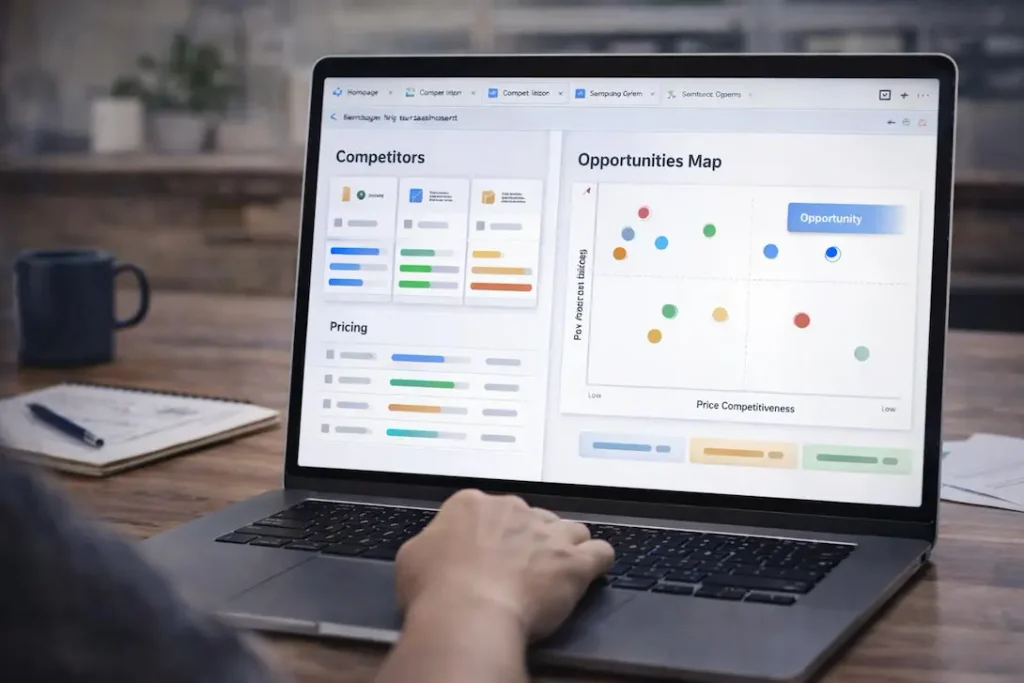
Competitive analysis examines businesses that serve, or could serve, the same customers. Its purpose is to understand the competitive environment and identify opportunities to create a distinctive value proposition.
Competitors should be evaluated systematically rather than judged only by their popularity or advertised prices.
Identifying Direct and Indirect Competitors
Direct competitors offer similar products or services to a similar audience. Indirect competitors address the same customer problem through a different solution.
For example, a paid training course may compete with another course directly and with free online tutorials indirectly.
Businesses should also consider potential entrants that could enter their market as technology, regulation, or customer demand changes.
Comparing Competitors
Collect publicly available information about important competitors, including their:
- Products and service offerings.
- Pricing and payment options.
- Target customers and positioning.
- Marketing channels and sales methods.
- Customer reviews and recurring complaints.
- Strengths, weaknesses, and apparent market gaps.
A comparison table can help organize the findings.
| Factor | Your business | Competitor A |
| Target audience | Busy professionals | General households |
| Main offer | Scheduled premium service | Standard service packages |
| Pricing | Mid-range | Low-cost |
| Key strength | Flexible scheduling | Broad availability |
| Potential opportunity | Specialized customer support | Faster service response |
This is a hypothetical example, not actual competitor research. Replace the entries with verified information about your industry.
Using Competitive Analysis to Make Decisions
Porter’s Five Forces is a framework for evaluating industry competition. It examines the threat of new entrants, the bargaining power of suppliers, the bargaining power of buyers, the threat of substitutes, and rivalry among existing competitors.
The framework helps businesses consider pressures beyond their immediate rivals. Strong supplier power, for example, may increase costs, while readily available substitutes may limit pricing flexibility.
Use the findings to identify gaps, improve your offer, and determine where your business can compete effectively. The objective is not to copy competitors but to make better-informed strategic choices.
10. Resource Allocation and Operational Planning
Resource allocation determines how a business distributes money, time, people, equipment, and technology across its priorities. Operational planning explains how work will be performed and how products or services will reach customers.
Both are essential because even a well-designed strategy can fail when the business lacks the capacity to execute it.
Prioritizing Resources
Most businesses cannot pursue every opportunity at once. Evaluate proposed activities according to expected impact, cost, urgency, and alignment with business objectives.
For example, a company may need to choose between hiring another employee, upgrading its software, and launching a new marketing campaign. The best choice depends on which constraint is currently limiting performance.
Resource allocation should also account for hidden costs, including training, maintenance, management time, and implementation delays.
Developing an Operational Plan
Operational planning typically addresses:
- Processes: The steps required to deliver products or services consistently.
- People: Responsibilities, staffing, training, and skills.
- Suppliers: The materials, services, and relationships the business depends on.
- Technology: Tools that support communication, production, and administration.
- Capacity: The amount of work the business can handle reliably.
- Quality control: Procedures for maintaining expected standards.
Documenting important processes reduces confusion and makes it easier to train new staff. Checklists, standard operating procedures, and clear responsibilities can improve consistency.
Example of Operational Planning
A photography studio wants to double its monthly bookings. Before increasing advertising, the owner should evaluate photographer availability, editing capacity, scheduling systems, and customer communication.
If the studio cannot deliver the additional work on time, higher demand may lead to delays and dissatisfied customers. Improving capacity before increasing sales can therefore be a better strategic decision.
Review resource utilization regularly. As the business changes, some activities may deserve more investment while others should be reduced or discontinued.
11. Business Decision-Making: Making Better Strategic Choices
Business decision-making involves choosing among alternatives to achieve a desired outcome. Because business owners rarely have complete information, the objective is not to guarantee perfect results but to improve the quality of the reasoning behind each choice.
A Practical Decision-Making Process
A structured process can make important decisions more consistent:
- Define the decision. State the problem or opportunity clearly.
- Gather relevant information. Review data, customer feedback, costs, and expert input.
- Identify alternatives. Include realistic options and, where appropriate, the option of taking no action.
- Evaluate costs and benefits. Consider financial, operational, and strategic consequences.
- Assess risks. Examine possible negative outcomes and their likelihood.
- Choose and implement. Select the option that best fits the objectives and available resources.
- Review the result. Compare actual outcomes with expectations and record lessons.
Useful Decision-Making Tools
A decision matrix compares alternatives against selected criteria, such as cost, expected impact, implementation time, and risk. Cost-benefit analysis estimates whether the expected benefits justify the costs. Scenario planning examines how a decision might perform under different future conditions.
These tools make assumptions more visible and help teams explain why they selected a particular option.
Avoiding Common Decision-Making Biases
Overconfidence can cause owners to underestimate risk. Confirmation bias encourages people to Favor information that supports their existing beliefs. The sunk-cost fallacy occurs when decisionmakers continue investing in a failing approach simply because they have already spent money or time on it.
To reduce these biases, seek opposing viewpoints, examine evidence that challenges your assumptions, and define clear criteria for reviewing a decision.
For costly or difficult-to-reverse decisions, invest more time in analysis. For small, reversible choices, a limited experiment may be faster and more informative than prolonged discussion.
12. Risk Management: Preparing for Business Uncertainty
Risk management is the process of identifying potential problems, assessing their likelihood and impact, and deciding how to respond. It helps businesses prepare for uncertainty instead of waiting for disruptions to occur.
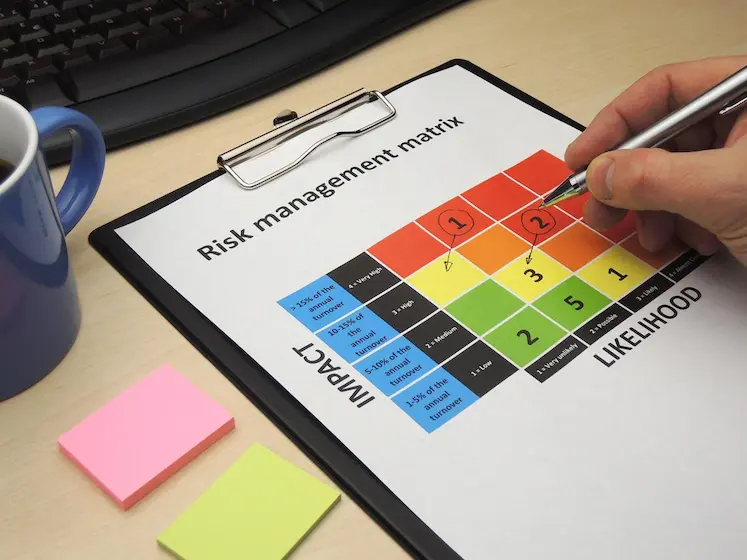
Common risks include declining demand, late customer payments, supplier failures, employee turnover, cybersecurity incidents, regulatory changes, and equipment breakdowns.
How to Identify and Assess Risks
A basic risk management process involves four stages:
- Identify potential threats to finances, operations, reputation, compliance, and customer relationships.
- Estimate how likely each risk is to occur.
- Evaluate the potential impact if it occurs.
- Prioritize risks and assign appropriate responses.
A simple risk register can organize this information.
| Risk | Likelihood | Potential impact | Possible response |
| Supplier disruption | Medium | High | Qualify a backup supplier |
| Late customer payments | High | Medium | Improve invoicing and follow-up |
| Data loss | Low to medium | High | Maintain tested backups |
| Seasonal sales decline | Medium | Medium | Forecast cash needs and adjust spending |
These ratings are illustrative. A real business should assess risks based on its circumstances.
Risk Mitigation and Contingency Planning
Businesses can respond to risks in several ways:
- Avoid: Stop an activity that creates unacceptable risk.
- Reduce: Introduce controls that lower the likelihood or impact.
- Transfer: Shift certain financial consequences through insurance or suitable contractual arrangements.
- Accept: Retain a risk when it is manageable and the cost of further mitigation is not justified.
Contingency planning identifies what the business will do if a significant event occurs. A business dependent on one supplier, for example, could identify an alternative supplier before a disruption happens.
Risk management should be reviewed regularly. New products, markets, employees, and technologies can introduce risks that did not exist when the original plan was created.
13. Competitive Advantage: Standing Out in the Market
Competitive advantage is a capability, position, or business characteristic that allows a company to deliver greater value to customers or operate more effectively than its rivals.
A meaningful advantage must matter to customers and be supported by the business’s actual capabilities. Simply claiming to provide better quality or service is not enough without evidence or a clear explanation.
Common Types of Competitive Advantage
Businesses may compete through several approaches:
- Cost efficiency: Operating at a lower cost while maintaining acceptable quality.
- Differentiation: Offering distinctive features, design, service, or expertise.
- Focus: Serving a specific customer segment particularly well.
- Convenience: Making purchasing or service delivery easier.
- Reputation and relationships: Building trust through consistent performance and customer knowledge.
- Innovation: Developing better solutions or improving existing processes.
These approaches can overlap. A specialized service business, for instance, may differentiate itself through expertise while also creating convenience for a narrowly defined customer group.
Identifying Your Unique Value Proposition
A value proposition explains who the business serves, what problem it solves, and why its offer is valuable.
To develop one, examine three questions:
- What do customers value most?
- What can your business deliver particularly well?
- What alternatives are customers using, and where do those alternatives fall short?
The strongest opportunities often emerge where customer priorities overlap with your capabilities and a gap in the market.
Maintaining a Sustainable Advantage
Consider a small IT support firm competing against larger providers. It may not be able to match their prices or staffing levels, but it could offer clients a dedicated technician who understands their systems and responds consistently.
For customers who value continuity, that service may be meaningful. However, the firm must maintain reliable response times and customer satisfaction for the advantage to remain credible.
Competitive advantages can weaken as rivals adapt or customer expectations change. Continue improving the capabilities that differentiate your business and check whether they still matter to your target audience.
14. Business Problem-Solving: Overcoming Business Challenges
Business problem-solving involves identifying the causes of a challenge, evaluating possible solutions, and implementing changes that improve the situation. It is more effective to understand a problem thoroughly than to rush into a solution that addresses only its symptoms.
Identifying the Root Cause
Start by describing the problem precisely. “Sales are down” is a broad observation. “Repeat orders from existing customers have declined over the past three months” gives you a more useful starting point.
Collect relevant information to establish when the problem began, where it occurs, and which factors may contribute to it.
The five-whys technique involves repeatedly asking why a problem occurred to investigate its underlying cause. It is a useful starting point, although complex problems may require more detailed analysis.
Evaluating and Testing Solutions
Once you understand the likely cause, generate several possible responses. Consider their cost, expected impact, implementation time, and potential side effects.
Where practical, test the most promising solution on a small scale before applying it across the business.
For example, a restaurant experiencing declining evening revenue might initially consider lowering prices. However, its records may reveal that longer waiting times are causing customers to leave. Revising staff schedules or improving order processing could address the actual problem more effectively than a price reduction.
Learning From Business Problems
After implementing a solution, measure whether the problem has improved. If the results are disappointing, revisit the assumptions and test another approach.
Documenting lessons helps prevent recurring mistakes and makes future decisions more informed. Encourage employees to report problems early and discuss them constructively rather than focusing on blame.
A systematic approach can turn business challenges into opportunities to improve operations, customer service, and management practices.
15. Business Growth, Scalability, and Long-Term Sustainability
Business growth involves increasing sales, customers, market reach, or other measures of business activity. Scalability refers to the ability to increase output without costs rising at the same rate. Long-term sustainability means maintaining the financial health, operational quality, and adaptability required to continue operating.

These concepts are related, but they are not interchangeable. Revenue can rise while profitability declines, and a business can grow rapidly without having the systems needed to support that growth.
Developing a Business Growth Strategy
Businesses can pursue growth by selling more to existing customers, attracting new customers, introducing products, entering new markets, forming partnerships, or acquiring other companies.
Each option requires different resources and carries different risks. A company should select opportunities that fit its capabilities, market demand, financial position, and long-term objectives.
Before entering a new market, investigate customer needs, competition, distribution requirements, and the costs of serving that market.
Building a Scalable Business
Scalability often depends on repeatable systems, documented processes, trained employees, and appropriate technology.
A consultant who personally delivers every project may be limited by available hours. A consultancy with documented methods, trained staff, and consistent quality controls may be able to serve more clients without relying entirely on the owner’s time.
However, automation and delegation require investment and oversight. They should improve efficiency without weakening service quality or customer relationships.
Maintaining Long-Term Sustainability
Healthy growth requires attention to more than sales figures. Important considerations include:
- Sustainable profit margins and cash flow.
- Customer satisfaction and repeat business.
- Employee development and retention.
- Reliable operational processes.
- Financial reserves and manageable obligations.
- Adaptation to changing customer needs and technology.
For example, a bakery opening several new locations must maintain consistent recipes, staffing, supply quality, and cash management. Expanding faster than its management systems can support may damage the reputation it has built.
The objective is not simply to grow quickly. It is to build a business that can support its growth without sacrificing financial stability or the value it delivers to customers.
16. Implementing and Measuring Your Business Strategy
A business strategy creates value only when it is translated into action. Even a well-researched plan can fail when priorities remain vague, responsibilities are unclear, or progress is not measured.
Turning Strategy into Action
Begin by converting strategic objectives into initiatives, tasks, deadlines, and assigned responsibilities. Make sure employees understand the priorities and how their work contributes to the overall goals.
Allocate the necessary time, money, and people to each initiative. A priority without adequate resources is unlikely to be completed as intended.
For example, if a business wants to improve customer retention, its action plan might include analysing customer complaints, introducing a follow-up process, training customer support staff, and measuring repeat purchases.
Measuring Performance with KPIs
Key performance indicators help businesses evaluate progress toward their objectives. The most useful indicators are directly connected to the results the company wants to achieve.
Common KPIs include:
- Revenue and revenue growth.
- Gross profit margin.
- Customer acquisition cost.
- Customer retention and repeat purchase rate.
- Conversion rate.
- Operating expenses and cash flow.
Choose measures that support your specific goals rather than tracking every available metric. If the goal is to improve profitability, revenue alone is insufficient; costs and margins must also be examined.
Reviewing and Updating Your Strategy
Establish a review schedule that matches the business’s needs. Weekly meetings may be appropriate for operational tasks, while monthly or quarterly reviews may be more suitable for broader objectives.
Compare actual performance with targets, investigate meaningful differences, and decide which actions need to change. Record important decisions so the team can evaluate their effects later.
Treat implementation as a continuous cycle: plan, act, measure, learn, and adjust. Changing a strategy in response to credible evidence is a sign of effective management, not necessarily a failure of the original plan.
Conclusion
Business planning and strategy give structure to ambition. Planning organizes the practical details of running a business, from finances and operations to staffing and marketing. Strategy guides the choices that determine where a company competes, how it creates value, and which opportunities deserve its attention.
Market research, measurable goals, competitive analysis, financial planning, and risk management strengthen the decisions made throughout the business. Resource allocation and performance measurement then help turn those decisions into practical results.
No plan eliminates uncertainty, and no strategy remains appropriate forever. What matters is developing the habit of making informed decisions, monitoring outcomes, and adapting when circumstances change.
If you are launching a business, begin by validating your idea and understanding your customers. If you already operate a business, review your goals, financial position, and competitive advantage. Build a realistic plan, put it into action, and improve it as you learn. Consistent, evidence-informed decisions provide a stronger foundation for sustainable growth.
Frequently Asked Questions About Business Planning and Strategy
What Is Business Planning and Strategy?
Business planning organizes a company’s objectives, resources, finances, and operations into a practical roadmap. Business strategy determines how the company will compete, serve customers, and achieve its long-term objectives. They work together to guide business decisions and execution.
What Is the Difference Between a Business Plan and a Business Strategy?
A business plan describes the business, its market, operations, financial requirements, and intended activities. A business strategy defines the choices that shape how the business competes and creates value. The plan helps translate those strategic choices into action.
What Are the Main Components of a Business Plan?
A typical business plan includes an executive summary, company description, products or services, market analysis, marketing and sales strategy, operational plan, management structure, and financial projections. The level of detail depends on the business’s purpose and whether it is seeking external funding.
How Do You Develop an Effective Business Strategy?
Start by clarifying your objectives and assessing your current position. Research customers and competitors, identify realistic strategic options, and select the approach that fits your capabilities and resources. Translate the strategy into measurable goals, assign responsibilities, and review progress regularly.
Why Is Market Research Important in Business Planning?
Market research helps businesses understand customer needs, demand, pricing expectations, and competing alternatives. It can reveal opportunities, test assumptions, and reduce the risk of investing heavily in products or services that lack sufficient demand.